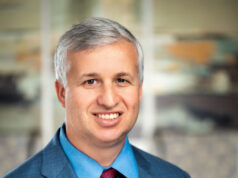
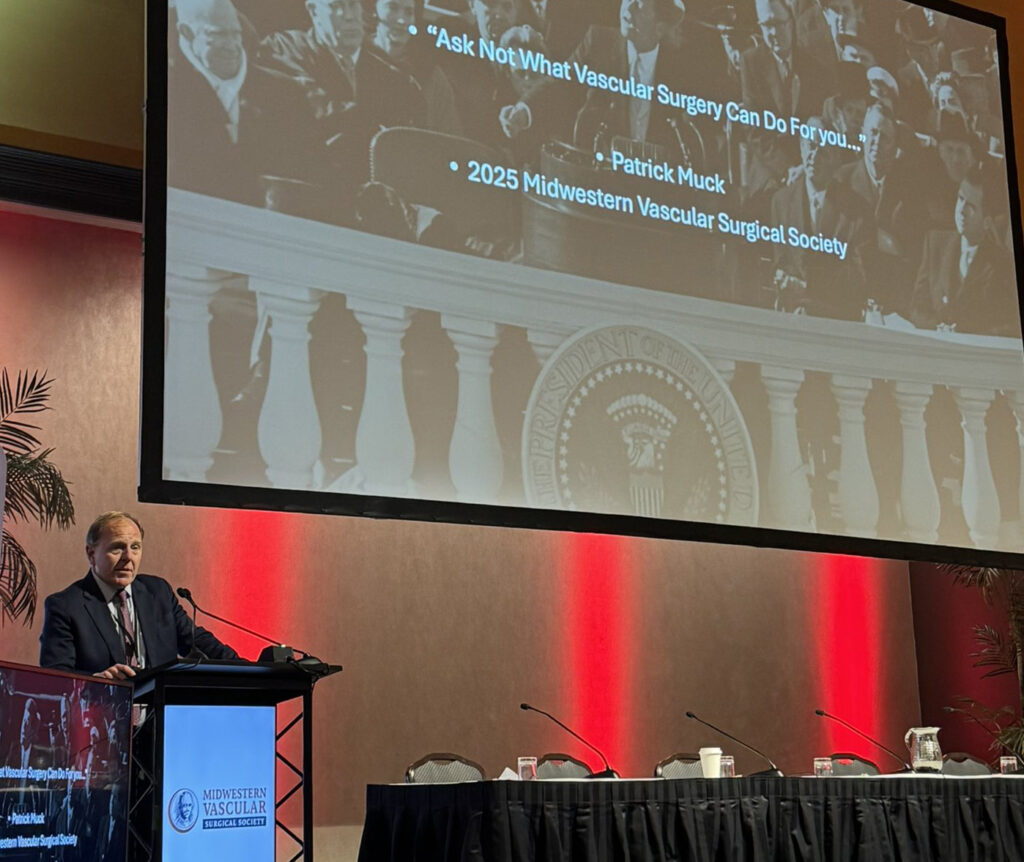
During his own recent presidential address on home turf, Patrick Muck, MD, invoked immortable words from the inaugural address of President John F. Kennedy to make a very serious point about radiation safety in vascular care: “Ask not what vascular surgery can do for you… ask what it can do to you.”
Muck said that with the rise in endovascular intervention over open surgery, and procedures becoming longer and more complex, the foundational principle in radiation protection of ALARA, or As Low As Reasonably Achievable, should be placed firmly into vascular surgery’s focus.
“It is aimed at minimizing exposure to ionizing radiation while considering economic, technical and social factors,” the 2024–25 Midwestern Vascular Surgery Society (MVSS) president and chief of vascular surgery at Good Samaritan Hospital in Cincinnati, Ohio, told those gathered in the Queen City for MVSS 2025 (Sept. 18–20). “It emphasizes optimization: justifying any radiation use and keeping doses as low as practical without a strict zero-exposure goal.” Yet its application, interpretation and associated dose limits have evolved, and “while the core principle hasn’t been overhauled, supporting elements like dose limits and implementation guidance has shifted.”
With little change over the decades, he said, are governing bodies suitably adapting to radiation protection technology now available to mitigate exposure?
“We’re doing more and more minimally invasively, whether it be aneurysm, peripheral arterial, TCAR [transcarotid artery revascularization], IVC [inferior vena cava] filter, venous and dialysis procedures,” he tells Vascular Specialist after the address. “Because of that, we’re getting longer and longer cases and more and more exposure to radiation. We know what radiation can do to us, but do we discuss this topic enough and the mitigation systems that are now out there?”
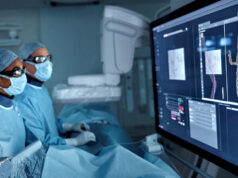
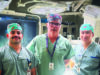
Muck referred to several emerging barrier protection technologies during his address, among them EggNest radiation protection, the Protego radiation protection shield and the Radiaction shield. Speaking to Vascular Specialist, he focused on one which was recently introduced at his center: the Rampart Guardian system, a ceiling-mounted or mobile radiation shield, aimed at providing barrier protection. “I showed a couple of cases we’ve done, one an endovascular aneurysm repair [EVAR] and the other bilateral iliac stent placement,” he says. “For the EVAR, we used the Rampart Guardian system and I showed how we received only 0.2mrem. The next day, when we did the bilateral iliac stents, we used traditional shields and personal lead protection and had 3mrem, 15 times the radiation, this is the same old personal protection and shielding we have been using for decades.”
The time is now to address radiation mitigation and consider bringing in systems like those from EggNest and Rampart Guardian, Muck added. “I believe we’re just at the infancy with barrier protection.”